Volume Analysis | Flash Update – 11.16.26

A Tale of Two Markets: Recalled to Life, but the Golden Thread Is Fraying
Volume Analysis Flash Update
Week ended November 13, 2026
By Buff Dormeier, CMT
Chief Technical Analyst, Kingsview Investment Management
With a nod to Dickens, it was a week of rising hopes and retreating capital, a season of recovery on the price screen and a season of caution beneath it. Both of our market cities, new era and old, attempted to emerge from the previous week’s storm. Yet an improvement in outward appearances did not necessarily represent an improvement in their inward defenses.
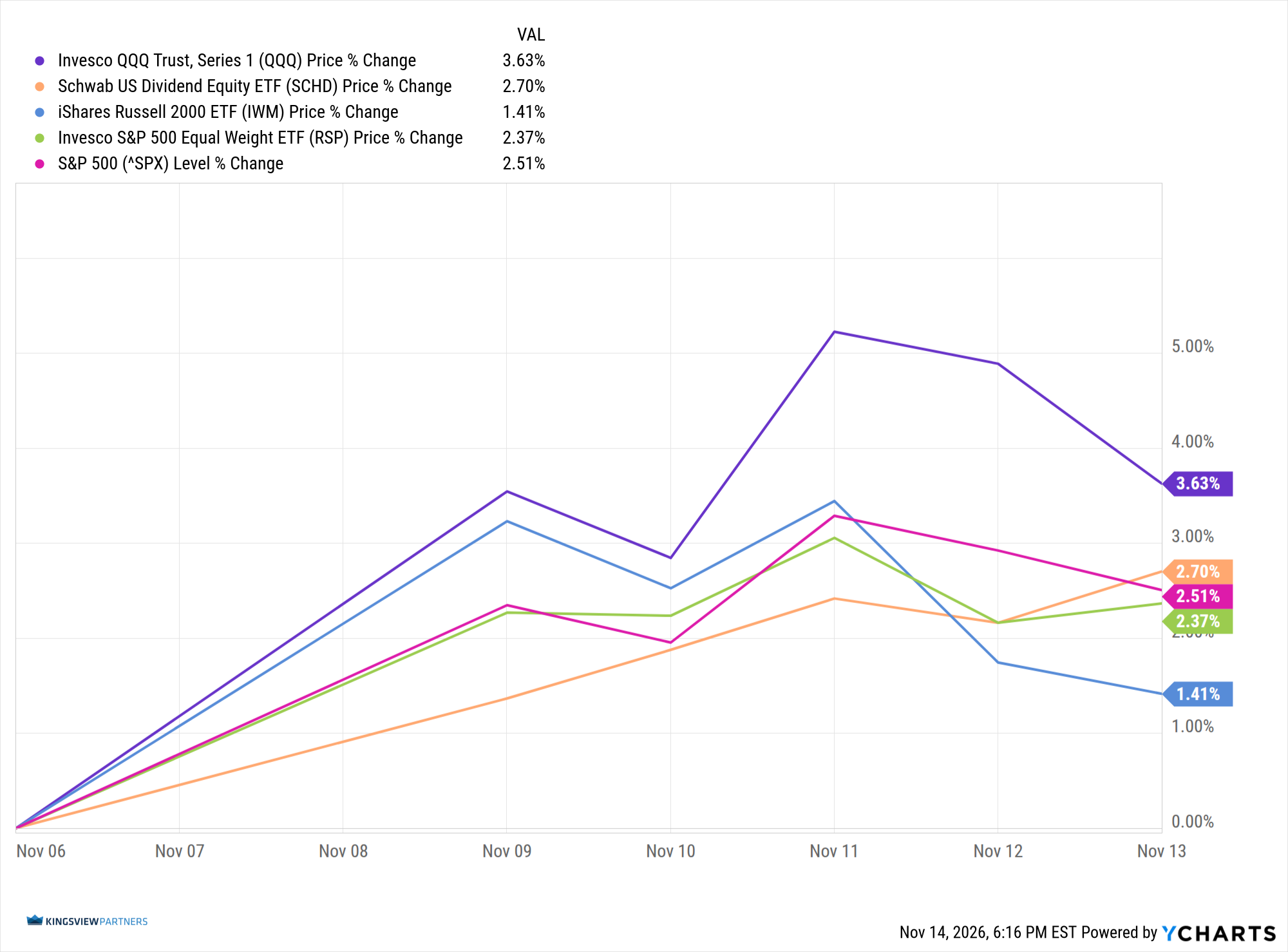
The New Era city, represented by technology and AI leadership, staged the stronger counterattack. The Old Era city, represented by established businesses, dividend payers, and broader participation, also recovered ground. Every regiment in our weekly comparison advanced. The S&P 500 gained 2.51%. On the surface, the campaign appeared to be repairing itself.
Beneath that surface, however, Capital Weighted Volume delivered a less reassuring dispatch. Prices recovered while accumulated capital sponsorship continued to deteriorate. The two markets were no longer distinguished only by New Era versus Old Era. They were also distinguished by what prices appeared to promise and what trading activity was willing to confirm. Although the bulls reclaimed some streets, they have not yet secured the supply lines.
Last Week’s Marching Orders: Repair Before Redeployment
Last week’s assignments began with repair. The S&P 500 needed to defend the 7,300 neighborhood and recover 7,500. The generals needed to preserve their response near 650 and reclaim 685. The troops needed to hold their trend defenses and establish themselves above 280. The lieutenants and dividend brass needed to demonstrate that their reversals were interruptions rather than the beginning of another sustained retreat. Most importantly, those price repairs needed improving upside participation and capital sponsorship.
This week delivered part of that assignment. The S&P 500 recovered 7,500, and all four formations posted positive weekly finishes. But the recovery remained contained within the prior battlefield boundaries, while the volume evidence weakened.
Our original “Doji Know?” commentary correctly identified the possibility of a change of command as October began. The generals hesitated at resistance while the broader formations found footing near support. That subsequent rotation deserved recognition. It did not earn the market a permanent exemption from inspection. A successful earlier reading of the field should sharpen our discipline, not soften it.
The Week’s Campaign: A Counterattack Beneath the Barricades
Wednesday, November 11, offered the bulls their most encouraging advance. The S&P 500 surged toward its 50-day moving average and finished near the session’s high, just beneath that reference. Approximately 83% of Capital Weighted Volume was directed to the upside, although total activity was only average.
Thursday brought the heavier artillery. Our research tally registered the second highest daily Capital Weighted Volume of the year and the second largest daily downside reading in the historical series. Approximately 85% of that activity was directed downward. Wednesday’s advance had an escort. Thursday’s retreat arrived with a convoy.
The defining battlefield remains Thursday, November 5, the record downside Capital Weighted Volume session discussed in the previous report. This week’s S&P 500 trading remained entirely within that session’s broad range, approximately 7,350 to 7,682. The market is still operating in the shadow of that bar.
Friday extended the pressure. The S&P 500 tested 7,500 before recovering some ground to close at 7,561.67. Capital Weighted Volume remained above average, with approximately 81% directed to the downside. The recovery from support was constructive price behavior, but the activity accompanying it resembled selling into strength.
A sustained move above 7,682, accompanied by improving sponsorship, would strengthen the case that the bulls are escaping that shadow. Failure beneath the upper boundary would leave the rebound vulnerable to another test of the lower defenses.
Within the range, 7,500 remains the immediate checkpoint. Below it, the 7,350 area is reinforced by the rising 200-day moving average near 7,340, followed by support near 7,300. Overhead, the 50-day average, now approximately 7,636, precedes the more consequential 7,682 range ceiling. A sustained advance through that ceiling would bring 7,770 back into view. These are distinct positions, not interchangeable lines on the map.
The Golden Thread: More Volume, Less Confirmation
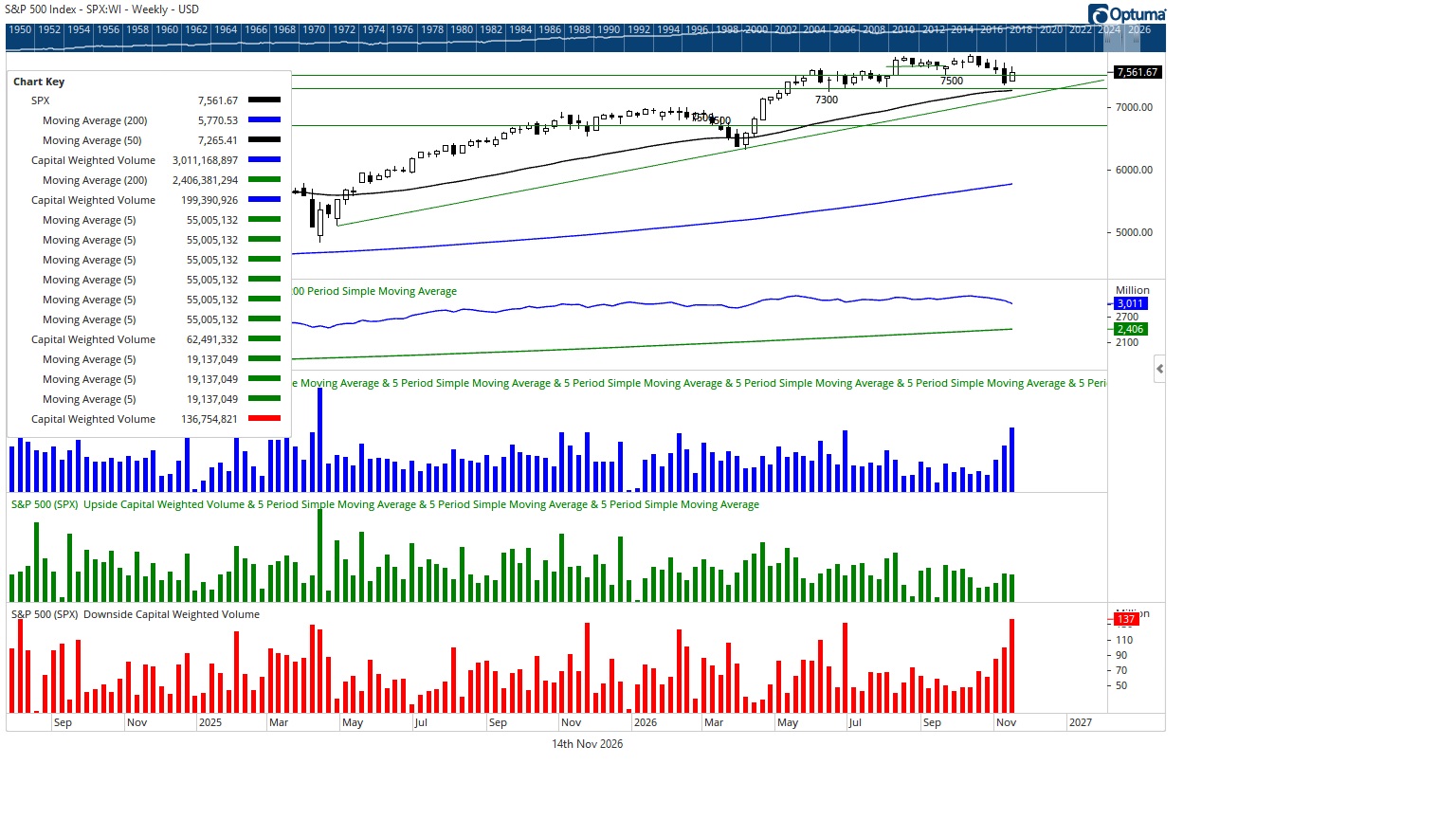
The weekly volume report deserves particular attention precisely because prices advanced. Our historical tally places total weekly Capital Weighted Volume at its highest reading of 2026 and its strongest since the record week ended April 11, 2025. Approximately 69% was directed to the downside, producing the largest weekly downside tally since March 2024. The supplied weekly chart shows approximately 199.4 million in total Capital Weighted Volume, of which approximately 136.8 million was downside activity.
This was not simply a high-volume week confirming higher prices. The direction of that volume matters. A weekly price return compares two endpoints. Directional volume accumulates the activity occurring between them. Prices can therefore finish convincingly higher even while the heaviest trading pressure is concentrated in declining securities and declining sessions. In our framework, that combination is consistent with institutional distribution into strength rather than a broadly sponsored accumulation campaign.
It is an interpretation of the trading evidence, not a direct census of institutional accounts. Nevertheless, the discrepancy is consequential: the market gained altitude while its underlying capital support weakened.
That distinction was central to our Second Half Outlook. A price recovery is not the same as durable sponsorship. The constructive path required broader leadership to attract sufficient capital to absorb the retreat from concentrated growth. The adverse path involved distribution overwhelming that rotation. This week’s price gains kept the constructive possibility alive, but the volume report strengthened the case for caution.
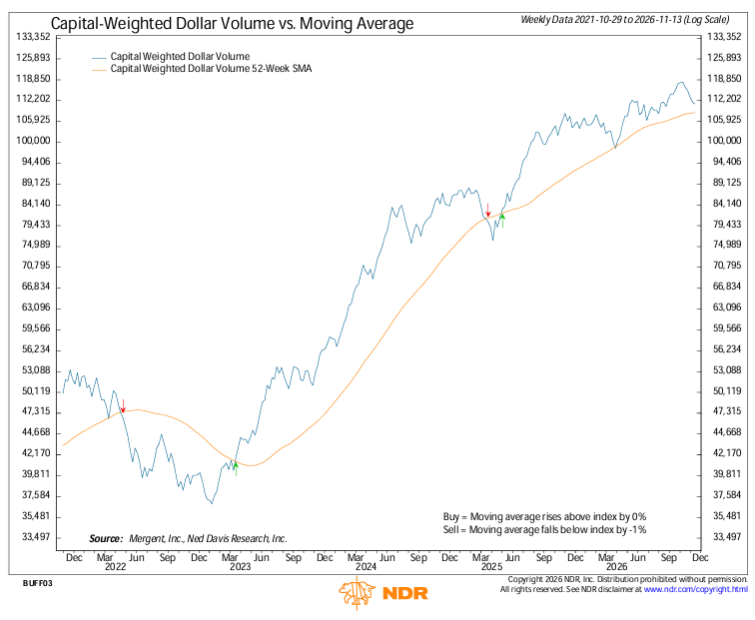
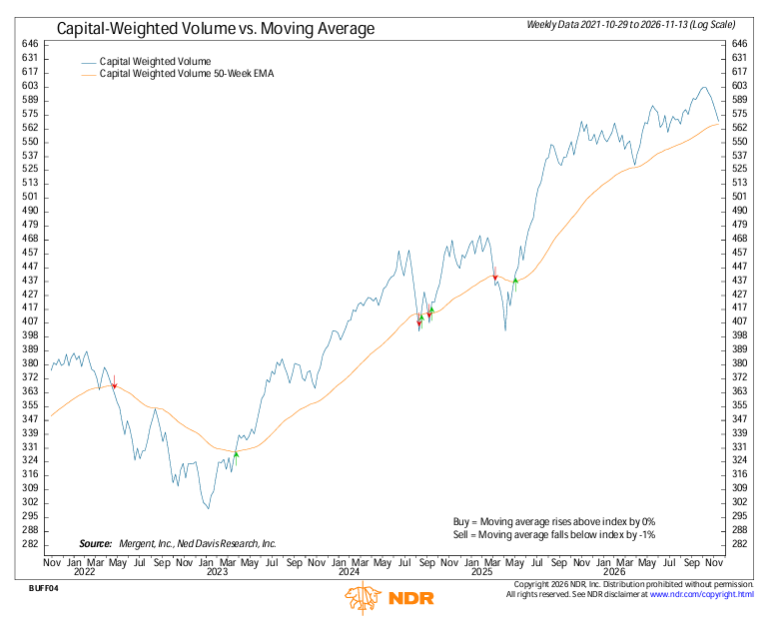
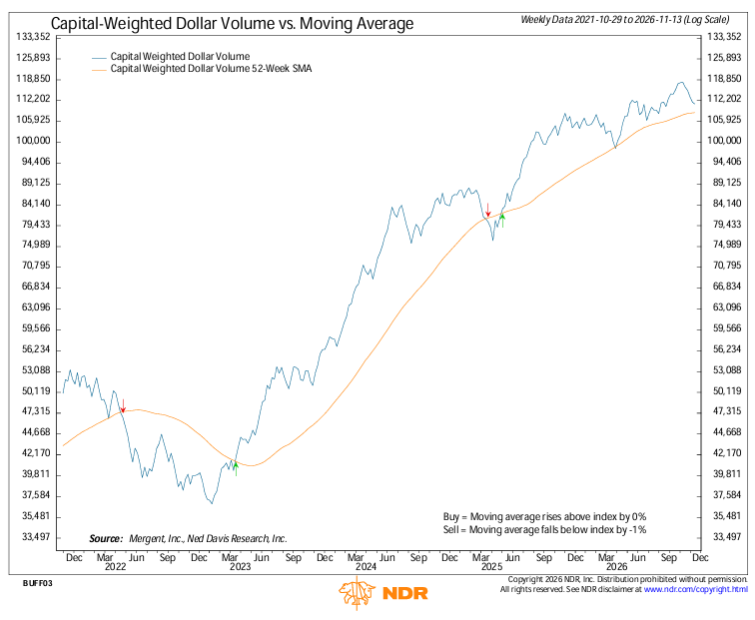
The longer weekly measures are approaching important decision points. Capital Weighted Dollar Volume declined again and is moving closer to its rising 52-week simple moving average. Capital Weighted Volume is even weaker, currently only marginally above its 50-week exponential moving average. The cushion separating the indicators from their respective trend references has narrowed materially. Under our Volume Analysis framework, a move more than 1% beneath either designated weekly trend reference shifts the assessment into correction mode, suggesting heightened caution.
The tactical warning has intensified; the strategic weekly defenses are now being tested. Price is the market’s testimony. Volume is its polygraph. This week, the contradiction between testimony and conviction became less comfortable.
The Regiments: Recalled to Life, but Still Inside the Lines
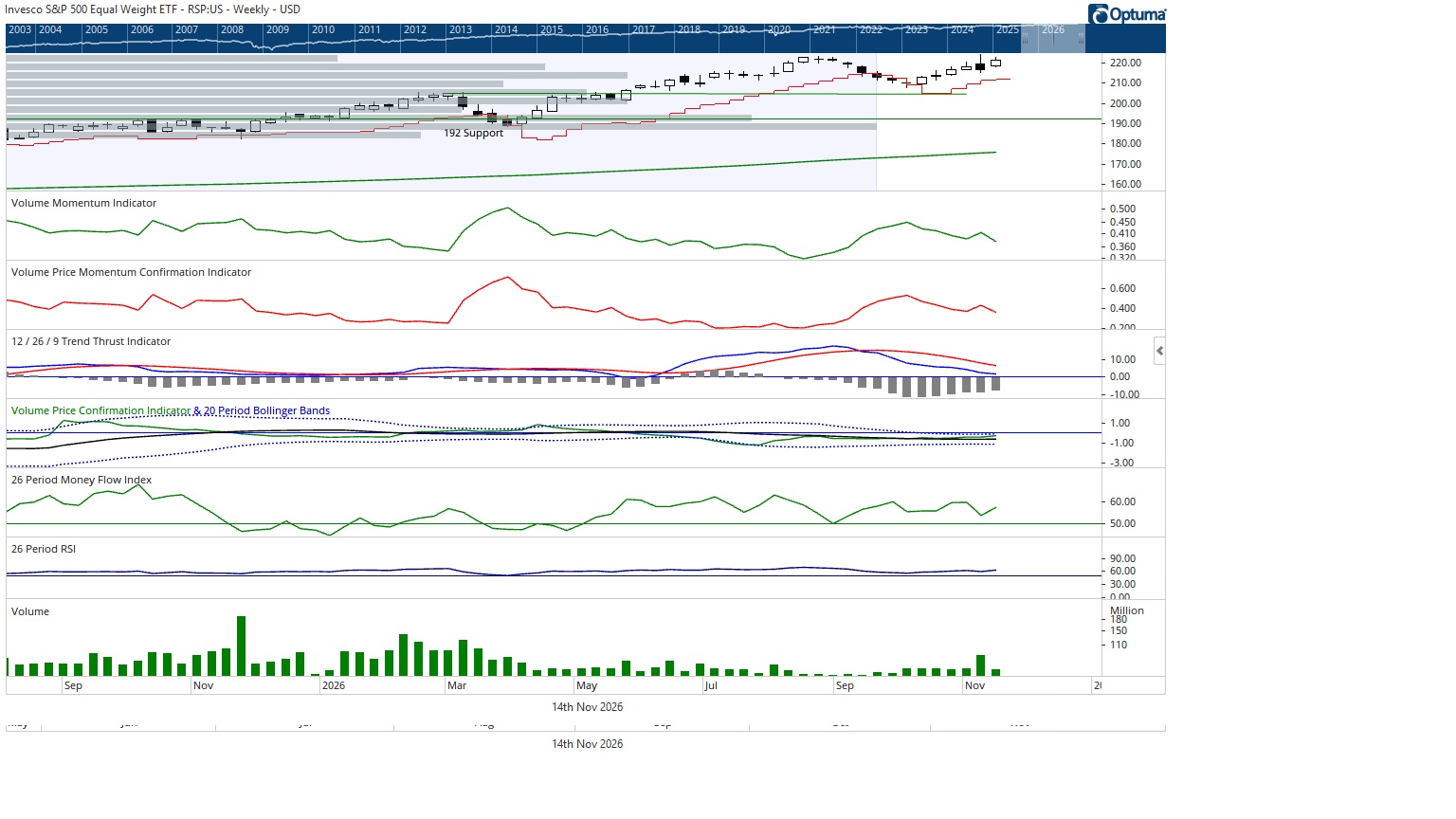
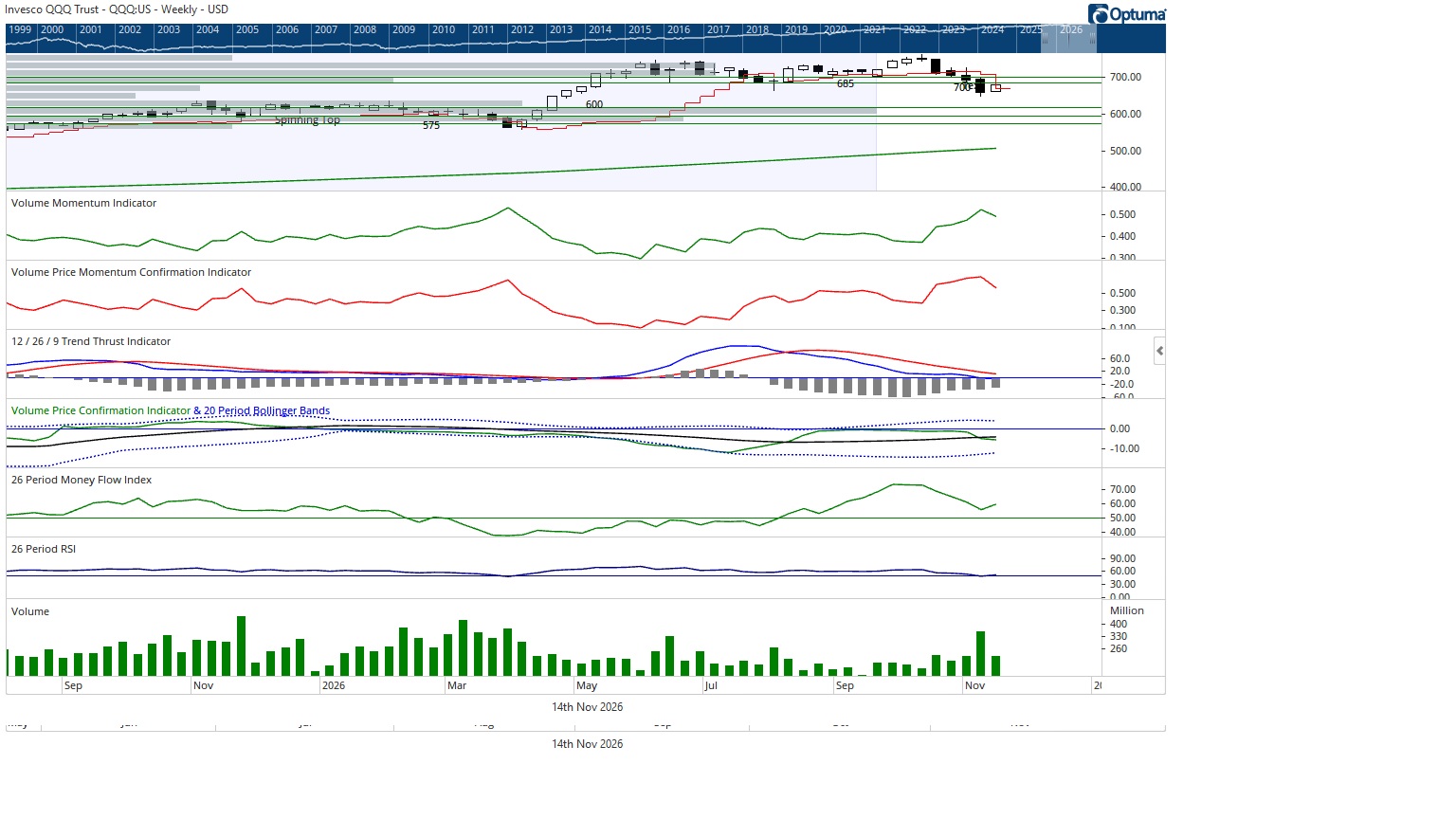
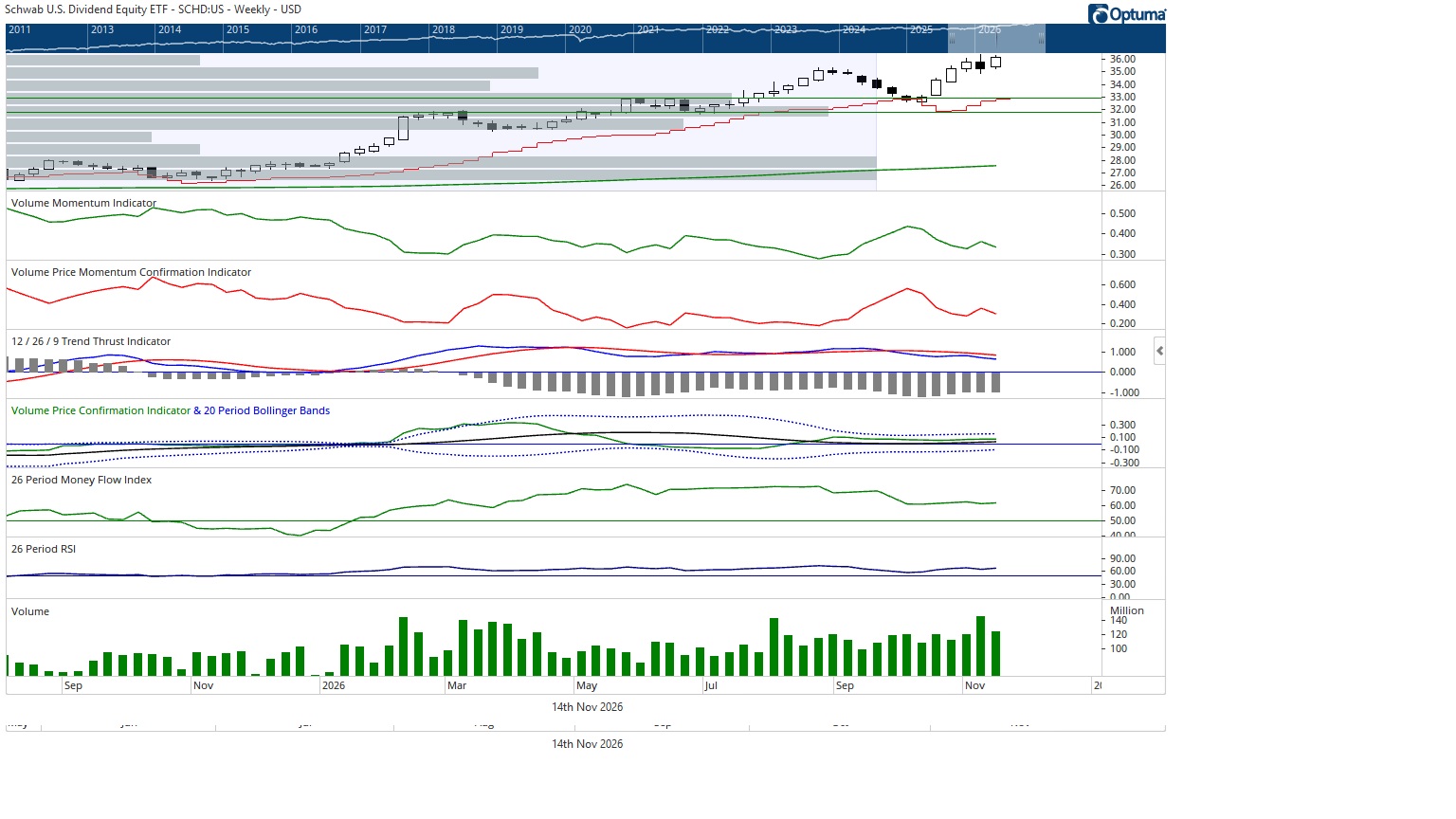
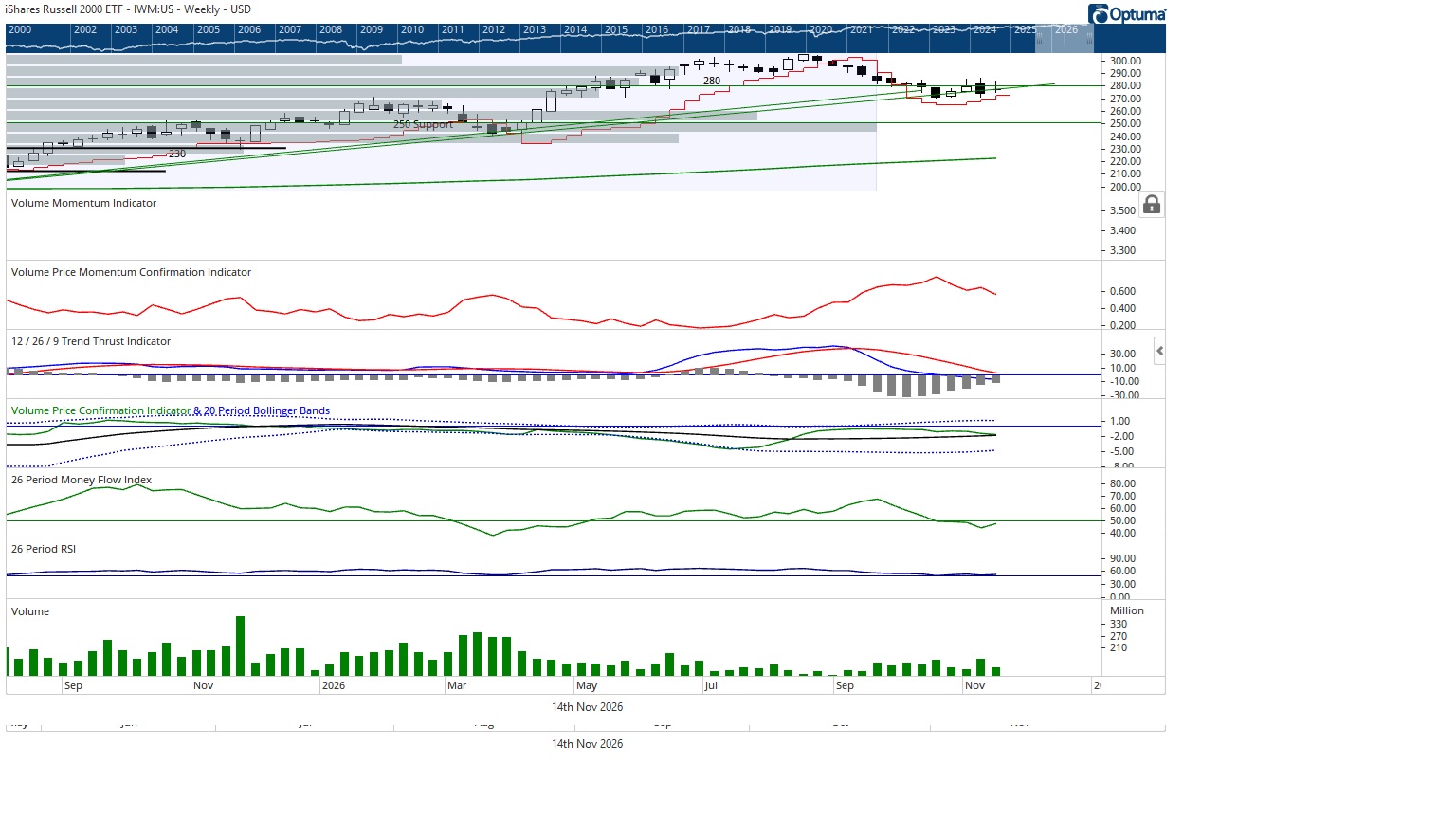
The generals, represented by the Invesco QQQ Trust, Series 1, led the rebound with a 3.63% advance. The dividend brass commanders, represented by the Schwab U.S. Dividend Equity ETF, followed with a 2.70% gain. The equal weight lieutenants, represented by the Invesco S&P 500 Equal Weight ETF, advanced 2.37%, while the small cap troops, represented by the iShares Russell 2000 ETF, gained 1.41%. Every formation recovered ground, although none escaped the shadow of their previous week’s range.
The generals challenged 700 before backing away. Their rebound demonstrates that some buyers are willing to embrace the New Era theme, but a temporary sortie above a breached position is not the same as securing it. The immediate assignment remains a sustained recovery of 685, followed by a convincing advance through 700. Below the market, 650 remains the first important defense, with 600 the deeper contingency should that position fail.
The dividend brass recovered strongly but did not clear the previous week’s upper boundary. Their price structure remains comparatively resilient, preserving the possibility that the Old Era quality theme may continue carrying more of the campaign. Yet the weekly momentum and volume panels are not uniformly confirming the recovery. The brass have returned to the review stand, but their orders require follow-through, not just a ceremonial salute.
The equal-weight lieutenants tested resistance near 223 and finished slightly below it. Their advance remains important because it distributes leadership more evenly across the large company universe. However, the weekly Trend Thrust Indication remains subdued, and the volume profile does not yet establish a decisive new offensive. Progress through 223, followed by the former high area near 225, would provide more persuasive evidence of renewed command.
The troops were the weakest advancing formation. Their close near 277 hugs the contested rising trend area but remains beneath 280 resistance. The weekly Money Flow Index improved, yet remained below its midpoint. The infantry is attempting to rebuild formation, but it has not secured the road out of the trenches. Sustained progress above 280, and then 285, would strengthen the broadening argument. The previously identified 270 area remains an important lower defense.
The distinction is straightforward: a market in which all units rebound is preferable to one in which all units retreat. But a synchronized rebound within the shadows of their damaged ranges is not yet a synchronized resumption of their uptrends.
Two Breadth Measures, One Important Test
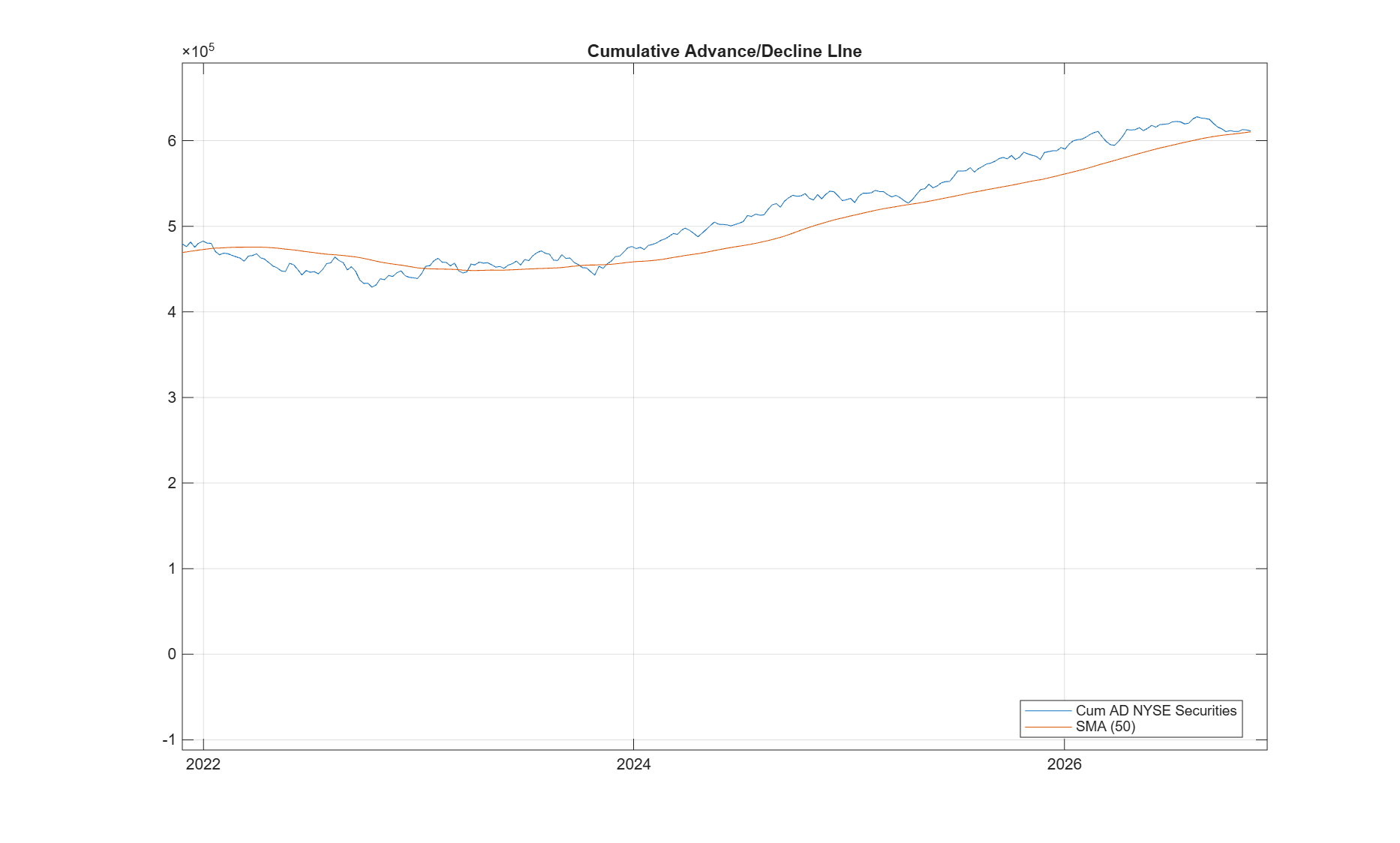
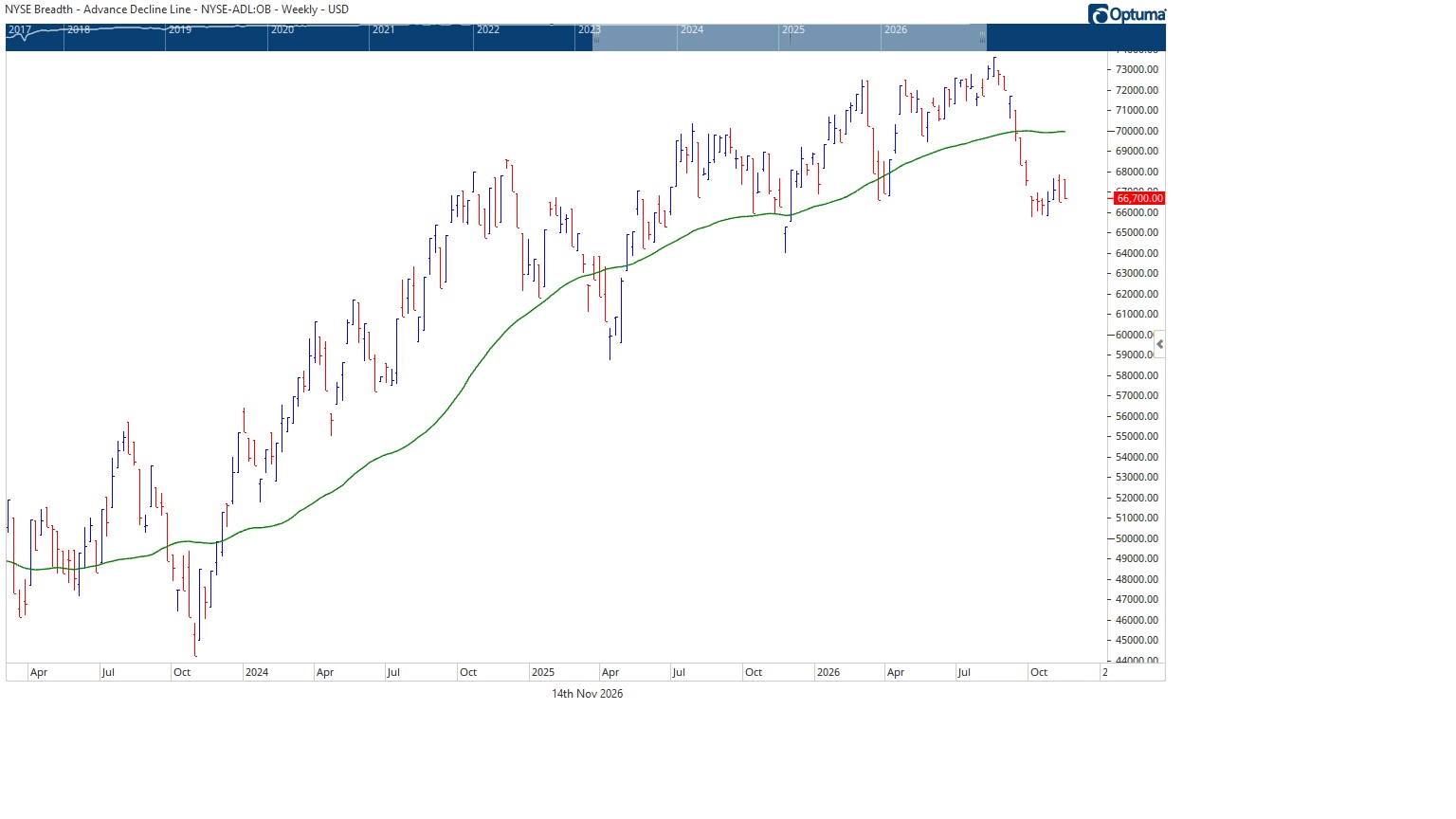
Despite the advance across our tracked formations, the NYSE all-issues Advance-Decline Line declined for the week, although it remained within the previous week’s range. The line continues to sit beneath the trend reference it surrendered back in September. The headline recovery was therefore not accompanied by equivalent repair in this broader participation measure.
The “common stocks only” breadth series we monitor through Bloomberg’s NYSE TRADCANY measure has told a somewhat different story. Unlike the all-issues line, it had maintained its trend support. That distinction matters because the two series measure different security universes. Their divergence is information, not necessarily an inconsistency.
However, the recent deterioration has now brought the common stocks-only line down to its own trend reference. The more resilient breadth measure is approaching the same sort of test that the capital measures are facing.
A confirmed breakdown in both Capital Weighted Volume and the common stock-only Advance Decline Line would carry greater significance than either development alone. In our framework, that combination would indicate a Volume Analysis bear market condition, supportive of more proactive defensive action. It would mean that weakening sponsorship and deteriorating participation were delivering the same message.
That condition should not be declared before it occurs. Nor should it be ignored because the price index has enjoyed a positive week. The inward campaign appears more fragile than the outward advance suggests.
Two Cities, Not Two Independent Kingdoms
The New Era versus Old Era distinction remains central to the story. Our earlier Yin-Yang thesis highlighted the unusually low, and at times negative, relationship between technology and communications leadership and oil, and now the remaining Old Era sectors. That supports the possibility that weakness in the New Era could coexist with resilience elsewhere. It does not establish a permanent hedge that the two cities cannot suffer together.
Our Market Outlook made a related distinction. A healthier bull market does not require the AI trade to disappear. It requires the market to become less dependent upon a handful of its most crowded beneficiaries. Leadership can extend from technology producers to infrastructure providers, enablers, adopters, and established businesses capable of converting productivity gains into stronger operating results.
That remains the constructive alternative within our And Then There Were None framework. The original concern was concentrated leadership losing sponsorship. And Then There Were Some described the opportunity for capable replacements to emerge across a wider field.
But replacement leadership must attract capital, not merely inherit attention. This is a mature bull market. Its healthier continuation requires participation to broaden and sponsorship to improve together. The two cities or themes can prosper through exchange rather than requiring one to fall for the other to rise. What they cannot do indefinitely is celebrate improving prices while the capital supporting those prices continues to retreat.
Next Week: The New Era Faces Another Examination
Two scheduled developments could make the coming week particularly consequential for the New Era city.
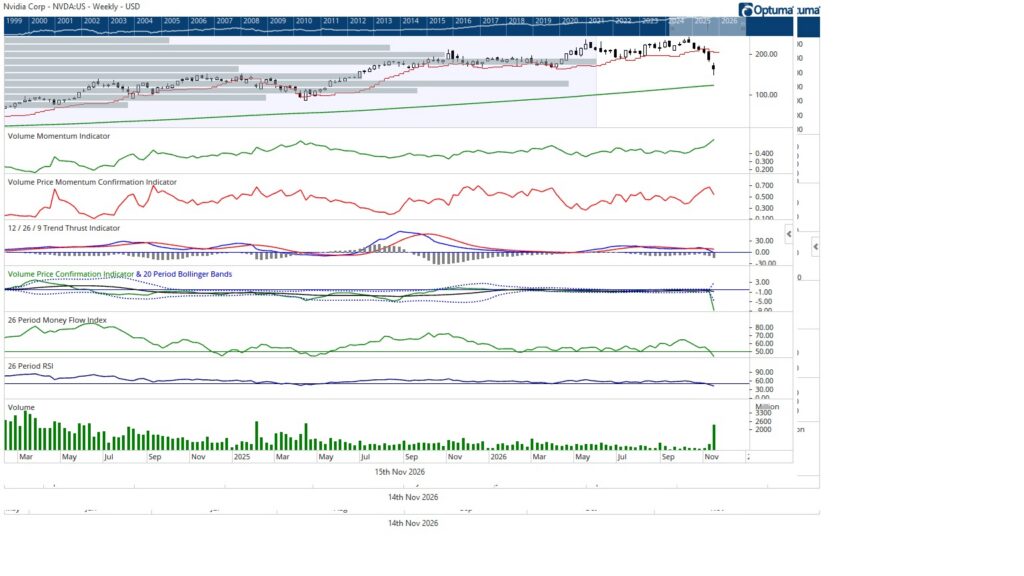
NVIDIA Corporation is scheduled to report its fiscal third-quarter results on Tuesday, November 17th. One of our wounded Nephilim now approaches an earnings examination while defending an important technical position.
During the week, NVIDIA broke beneath major support near $160 before finding buyers and recovering to approximately $162. Weekly trading volume expanded sharply, reaching levels comparable with the elevated activity around January and April 2025, when temporary lows developed. That comparison is worth monitoring, but it is not a capitulation verdict. The current chart also shows deterioration in the Volume Price Confirmation Indicator and Money Flow Index.
Price and volume momentum have not established a sufficiently clear bullish divergence to make the next move obvious. The response around $160 is evidence that buyers appeared. The next question is whether they remain after the earnings news arrives.
The market’s reaction may be more informative than the headline results alone. A constructive response would preserve the support recovery and attract follow-through. A failure to hold that recovery would suggest that even substantial trading interest has not exhausted the available supply.
Anthropic’s offering adds another potential demand on capital. Its IPO pricing is expected on November 18, with trading anticipated to begin November 19, subject to the offering proceeding as planned.
The liquidity question echoes the concern raised around SpaceX earlier in the year. A large new offering can create competition for allocations within an already crowded theme. Investors may fund participation from cash, new commitments, or sales of existing holdings. The possibility that some of that funding comes from established generals deserves attention, particularly while their sponsorship is already weakening.
That is a potential funding rotation, not an automatic market outflow. A successful offering could also attract fresh capital. Our task is to observe which effect dominates rather than assume that every new arrival either strengthens or drains the entire army.
Rates and the Calendar: A Tailwind Meets a Tollgate
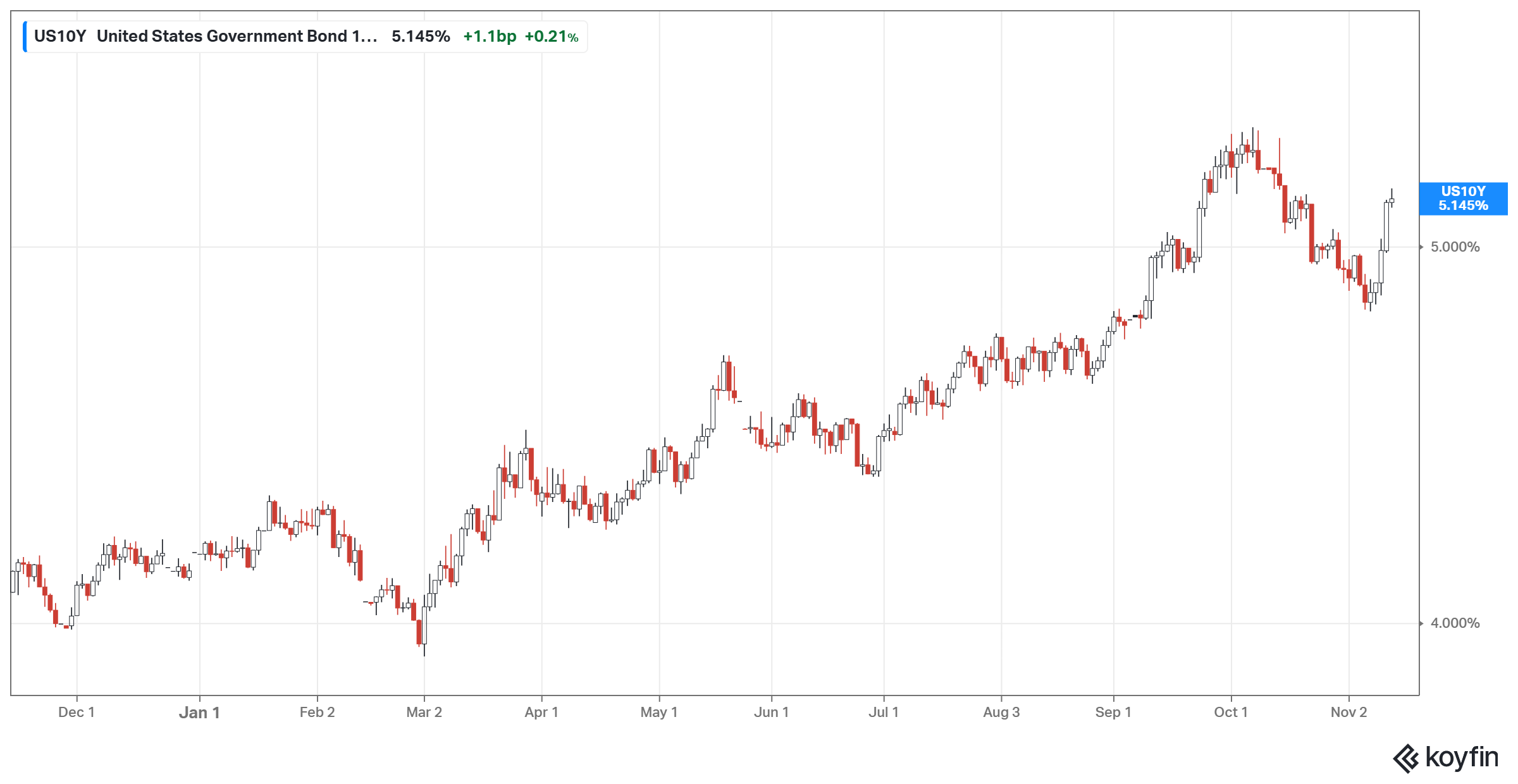
The bond market supplied another important complication. The 10-year Treasury yield rebounded from roughly 4.8% to 5.145%, an increase of approximately 35 basis points from the recent low. That is a meaningful repricing over a short interval.
The inflation news was mixed rather than uniformly reassuring. Friday’s producer price report showed a 0.3% monthly increase, slightly below the 0.4% consensus expectation. But Tuesday’s consumer price report had exceeded expectations. A modestly softer producer price headline did not reverse the week’s broader rise in yields.
In our reading, higher yields raise the hurdle for both cities. For the generals, they sharpen scrutiny of valuations and future earnings expectations. For the troops and other economically sensitive businesses, they keep financing conditions relevant to the recovery. The price of money is charging a higher toll just as the equity market is trying to reopen its roads.
There is nevertheless a constructive seasonal consideration. The period following midterm elections has historically often been favorable for equities as election uncertainty recedes. That tendency deserves a place in the assessment, but it is not a deployment order. Historical averages describe prior campaigns, not the outcome of the current one.
As our Second Half Outlook emphasized, a presidential cycle tailwind without volume confirmation remains a seasonal possibility. With improving capital sponsorship and wider participation, it becomes a more compelling investment case. The calendar can offer encouragement. It cannot repair the supply lines by itself.
Commodities at the Gates
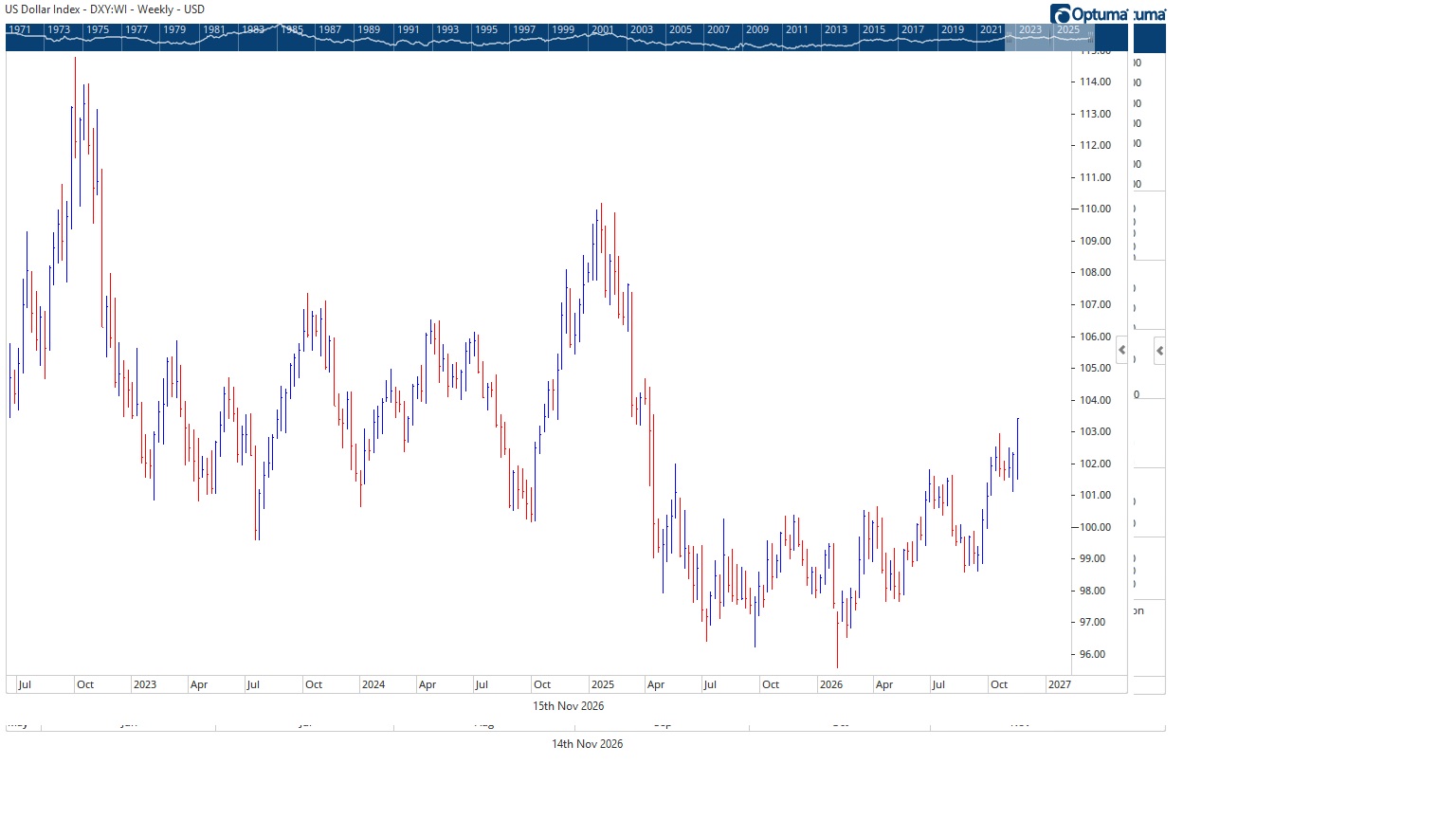
The U.S. Dollar Index advanced sharply, extending the pressure surrounding the recent breakout area. That stronger currency backdrop adds another consideration for the commodity trade, although it does not explain every movement within it.
Gold and silver briefly probed above the previous week’s upper boundaries but failed to sustain the advances and finished slightly lower. Gold’s immediate trading framework is approximately $3,800 to $4,200, while silver’s is approximately $48 to $54. The lower boundaries represent defenses to monitor; the upper boundaries represent recovery positions still to be secured. Neither metal has yet established a decisive escape from its recent range.
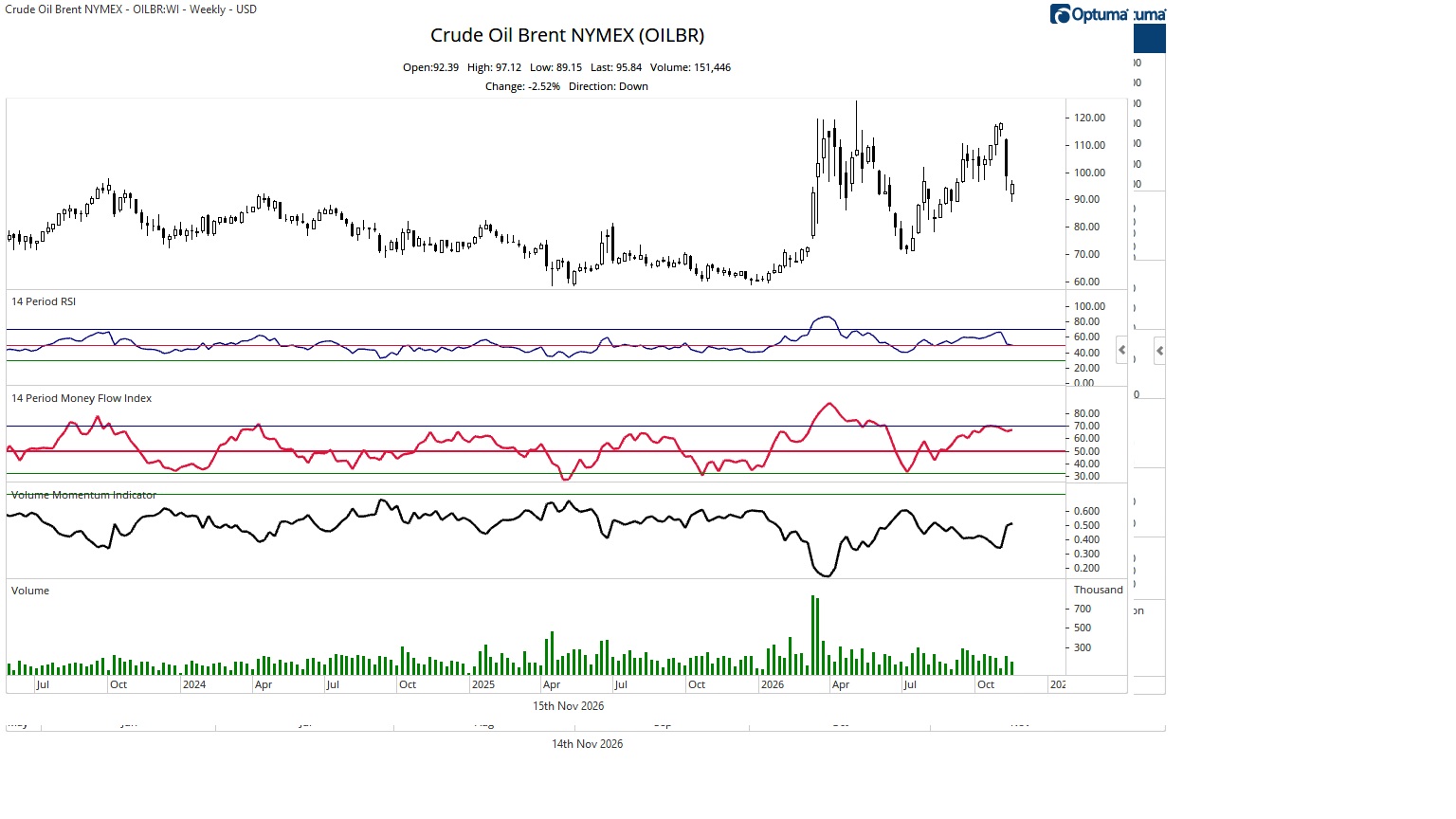
Brent crude offered an intraweek recovery. After finding buyers near $90, it recovered to approximately $95.84, above its weekly open but still below the previous week’s close. The chart records a -2.52% weekly decline. The new tactical boundaries remain approximately $88 to $98, with buyers attempting to defend the lower portion of that range. The energy scouts found their footing. They have not yet reopened the upper gate.
Risk Command: Protect the Capital, Not the Plot
This week’s rebound deserves acknowledgment. The S&P 500 recovered 7,500, every tracked regiment advanced, and the stronger Old Era formations retained the opportunity to resume their leadership. Those are constructive developments.
But the more demanding evidence lies beneath them: exceedingly heavy downside activity, declining accumulated capital measures, and breadth approaching its own trend test.
The bulls’ marching orders for this upcoming week is not simply another positive close. It is a recovery that holds its ground and improves internal sponsorship. The S&P 500 needs to preserve 7,500, defend the 7,350 to 7,300 neighborhood if challenged, and work through the 7,682 ceiling with conviction. The generals need to secure their recovery checkpoints rather than briefly visit them. The troops need to regain 280. The lieutenants and brass need to convert resilience into sustained advances beyond their recent ranges. Most importantly, the capital and breadth measures need to stabilize before their narrowing cushions become confirmed breaks.
A constructive resolution remains alive: selling pressure recedes, the range resolves upward, and broader leadership attracts enough capital to support a durable advance. The adverse resolution would see rebounds repeatedly met with supply. Under that outcome, defending capital would take precedence over defending the broadening rotation thesis.
For portfolio decision makers, concentration awareness, position sizing, liquidity planning, and predetermined risk thresholds remain the practical instruments of command. A favorable seasonal window should not override a confirmed deterioration in the evidence. Equally, overly-heightened caution should not prevent participation until the weight of the evidence is validated.
With another nod to Dickens, the market may yet be recalled to life. But hope is not confirmation, and a rebound is not absolution. It is a far, far better thing to protect capital than to protect a prediction. Risk management still gets the final word.
Grace and peace,
BUFF DORMEIER, CMT



Updated: 11/9/2026. Historical references do not assume that any prior market behavior will be duplicated. Past performance does not indicate future results. This material has been prepared by Kingsview Wealth Management, LLC. It is not, and should not, be regarded as investment advice or as a recommendation regarding any particular security or course of action. Opinions expressed herein are current opinions as of the date appearing in this material only. All investments entail risks. There is no guarantee that investment strategies will achieve the desired results under all market conditions and each investor should evaluate their ability to invest for the long term. Investment advisory services offered through Kingsview Wealth Management, LLC (“KWM”), an SEC Registered Investment Adviser.