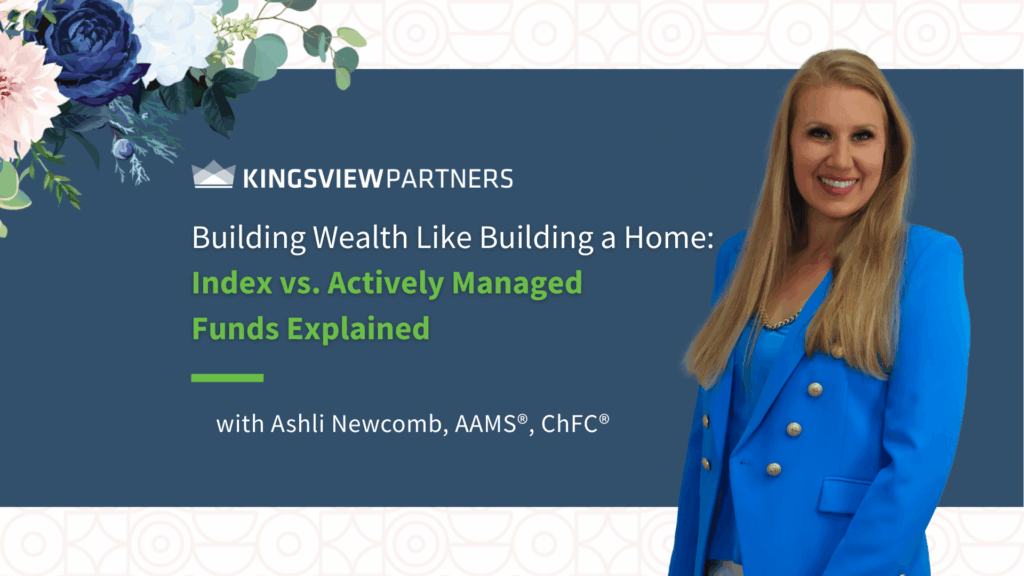
Building Wealth Like Building a Home: Index vs. Actively Managed Funds Explained
What to Know About Index Funds vs. Actively Managed Funds (and How It Relates to Your Retirement Goals)
When it comes to investing for retirement, one of the most common questions I hear is: “Should I go with index funds or actively managed funds?”
It’s a great question—because the answer isn’t one-size-fits-all. The choice has everything to do with your goals, your timeline, and even your personality as an investor. Let’s break it down.
What’s the Difference?
- Index Funds
These are designed to track a market index, like the S&P 500. They’re built to mirror the performance of the broader market. Because of this, fees tend to be lower and performance tends to be very close to the “average market return.” - Actively Managed Funds
These funds have a team of managers making decisions about what to buy and sell, trying to beat the market. Because of this active oversight, the fees are usually higher—and the performance can vary more widely.
Pros and Cons in Plain English
- Index Funds: Lower cost, broadly diversified, less management required. The downside? You’ll never outperform the market—you’re simply matching it.
- Actively Managed Funds: Potential to outperform, flexibility in adjusting to market conditions. The downside? Higher fees, more risk of underperforming, and less predictability.
Think of It Like Building a Home
Your retirement is a lot like building your dream home.
- Index funds are the foundation and frame.
They’re solid, steady, and reliable. You may not see anything flashy, but they give you the strength and stability to build on. Without them, the house doesn’t stand. - Actively managed funds are the custom finishes.
They’re like the upgraded kitchen, the designer light fixtures, or the perfect paint color. They can absolutely add value and beauty, but they come at a higher cost—and if chosen poorly, they may not add as much as you hoped.
But here’s the key: the real magic isn’t in choosing only a strong foundation or only great finishes. It’s in having a blueprint—a clear plan that ties everything together. That way, the foundation supports the finishes, and the finishes reflect your vision.
That’s exactly how retirement planning works. The mix of index and actively managed funds should be guided by your blueprint—the goals, dreams, and lifestyle you want to enjoy.
What This Means for Your Retirement
When you’re investing for retirement, the real question isn’t just “Which fund is better?”—it’s how does this choice serve the future life you’re building?
- If your goal is steady, reliable growth over decades, index funds can give you broad exposure with fewer costs eating into your returns.
- If you’re closer to retirement—or if you’re someone who values professional oversight and targeted strategies—an actively managed fund might feel like the right fit. But keep in mind: higher costs mean your investments have to work harder to keep pace.
The Bottom Line
There’s no “right” answer for everyone. But there is a right answer for you—and that’s where financial planning comes in. By reviewing your goals, your timeline, and your comfort with risk, we can design a portfolio that balances cost, performance, and peace of mind.
Ready to see how index and actively managed funds could fit into your retirement blueprint? Schedule a time with me here.
Investment advisory services offered through Kingsview Wealth Management, LLC (“KWM”), an SEC Registered Investment Adviser. Insurance products and services are offered and sold through Kingsview Trust and Insurance Services (“KTI”), by individually licensed and appointed insurance agents. KWM and KTI are subsidiaries of Kingsview Partners. KWM is an investment adviser registered with the Securities and Exchange Commission (“SEC”). Information presented is for educational purposes only and does not intend to make an offer or solicitation for the sale or purchase of any specific securities, investments, or investment strategies. Investments involve risk and unless otherwise stated, are not guaranteed.