Kingsview CIO Scott Martin On Fox Weather Now – 11.19.25
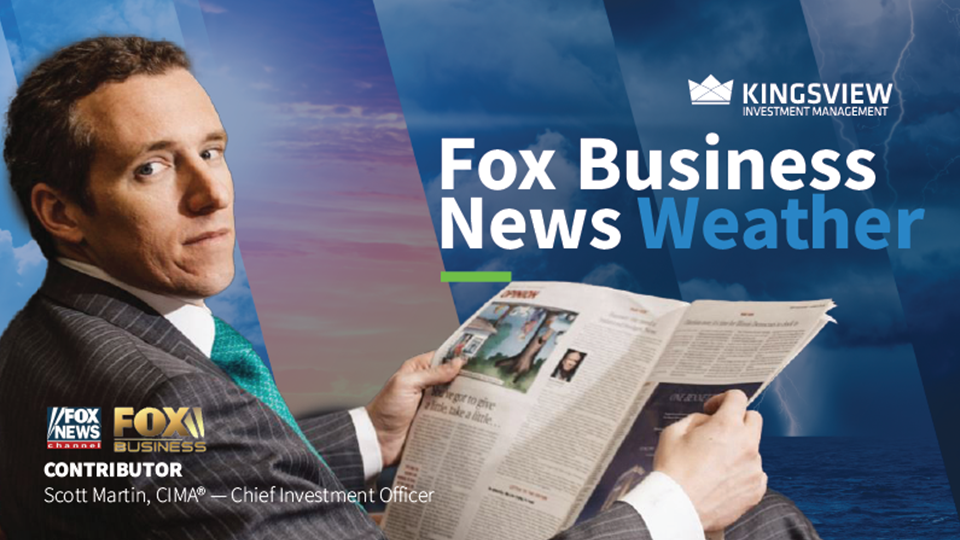
Click here to listen to the full segment.
IAN OLIVER: Thanksgiving is right around the corner, which means we’re approaching the busiest travel days of the year. This year’s domestic travel is expected to set a new record, with nearly 82 million Americans expected to travel next week.
But some travelers are still dealing with headaches from the recent government shutdown, which affected thousands of flights for weeks. The Federal Aviation Administration — the FAA — announced yesterday that operations are finally fully back to normal and that they’re ready for the big Thanksgiving travel week.
Still, the U.S. travel economy took a massive hit. Will the consequences make their way to the American consumer — to travelers?
Chief Investment Officer at Kingsview Wealth Management Scott Martin joins us now with insight. Scott, great to have you back. What are you expecting here? These were big economic losses during the shutdown. Is that going to impact Thanksgiving travel, or more likely Christmas and New Year’s?
SCOTT MARTIN: It depends. We’re talking about billions of dollars that were lost — or maybe just pushed off — into this part of the year. That makes my answer a little mixed, because some folks, like my mother for example, don’t want to travel now because of the headaches they experienced a few weeks ago.
But others who didn’t travel or had issues might want to travel now — either because they missed a trip or want to see if things have improved. So net-net, it’s probably going to even out.
The real question now is what you mentioned: we’re heading into the real travel season with record numbers. Are the employees and the infrastructure ready to handle that? I feel for the people who were working without pay — stressed out, overwhelmed, trying to get planes in the air while short-staffed.
So the big question is: Are they ready for things to operate at full capacity again? There may have been attrition among air-traffic controllers, TSA workers, and others. Hopefully they’re ready for another record season, because that’s exactly what we’re going to get.
IAN OLIVER: Yeah, and I’m curious about pricing. As you said, a lot of us have a bad taste in our mouths from recent travel experiences. Toward the end of the shutdown, airlines were losing hundreds of millions of dollars a day. They took a huge financial hit.
Are they going to try to make that up? Do you expect higher prices moving forward?
SCOTT MARTIN: Well, these are for-profit companies, so I assume they’ll try to get some of that back. I don’t know if they’ll ask the government for help, given the government was partly responsible for grounding planes.
But think about who else missed out:
- the cab drivers and rideshare drivers,
- airport workers,
- vendors in airports,
- and the businesses travelers would have spent money at.
The ripple effect was massive. So yes, there’s a chance we’ll see higher prices as we return to normal — simply based on supply and demand. If demand stays strong, prices may go up, and some travelers will unfortunately have to pay them.
But in a way, that’s a good sign — it means we’re getting back to normal, even if the path there has been a little… wacky.
IAN OLIVER: Now let’s look ahead with weather in the mix. Early next week, we’re watching the Southern hubs — Houston, Dallas — possibly getting rain and wind.
After such a rough stretch during the shutdown, airlines really need a smooth, profitable holiday period to finish the year strong. How problematic could things get if we have high-impact storms next week and through Christmas and New Year’s?
SCOTT MARTIN: It doesn’t look great, last I checked. This time of year is already tricky in a lot of places, and by January or February — forget about it. We’re going to get winter in the Midwest and Northeast sooner or later.
We’re due for something rough. You mentioned the big storm heading up the Northeast next week, and the models show ice and snow hitting the Midwest pretty quickly after that. So we may be making up for a couple of mild winters.
That will obviously be a problem for airlines who have to juggle all that. But as travelers, we may just be used to it — weather delays are more natural than government-caused shutdown delays.
Still, you know that old PTSD could kick in for people who were stuck for days because of the government issues. None of that makes travelers feel good — or eager to travel.
IAN OLIVER: Ideally we move on from this turbulent stretch, get some turkey, some good food, and keep rolling through the holidays.
SCOTT MARTIN: Let’s hope it waits for us.
IAN OLIVER: That’s the Chief Investment Officer at Kingsview Wealth Management, Scott Martin. Scott, great to have you back with us. Happy Thanksgiving if I don’t see you.